
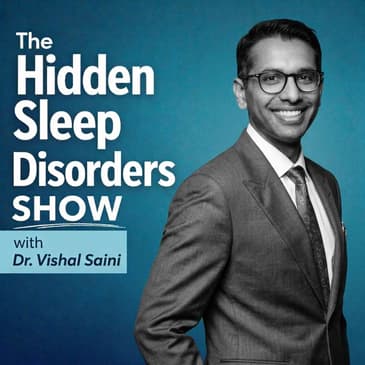
Welcome back to the Hidden Sleep Disorders Show, where today’s episode delves into the complex and often misunderstood world of circadian rhythm disorders. Dr. Vishal Saini focused on the science behind our body’s 24-hour internal clock, the critical role of light in regulating sleep, and how disruptions to our circadian rhythms can profoundly affect our mental and physical health. One concept discussed was the difference between simply being a “night owl” and living with a true circadian rhythm disorder, including the real-life challenges faced by students, shift workers, and those dealing with jet lag. Dr. Saini also explored how diagnosing these disorders requires more than a single test, highlighting the importance of tracking sleep patterns and understanding individual variations. A key theme that emerged was the importance of correctly timing light exposure and melatonin to reset the internal clock, as well as the long-term consequences of leaving circadian rhythm disorders untreated. Join us as we uncover why these conditions are so often missed and what practical steps can help realign your internal schedule for better health and wellbeing.
Timestamps:
00:00 Understanding circadian rhythm basics
05:32 Explaining circadian rhythm disorders
07:50 Discussing circadian sleep disorders
13:01 Health risks of night shifts
14:12 Discussing impact of jet lag
17:46 Discussing sleep tracking technology
23:35 Impact of light on mental health
26:03 Using melatonin to adjust sleep time
30:10 Managing sleep and light exposure
31:47 Show wrap-up and listener reminder
Understanding Circadian Rhythm Disorders: Insights from the Hidden Sleep Disorders Show
Navigating the world of sleep health can be overwhelming, but understanding the body's internal clock, also known as circadian rhythm, is a crucial step toward better well-being. The Hidden Sleep Disorders Show recently featured an insightful discussion about circadian rhythm disorders, the difference between natural sleep variations and true disorders, and why so many people struggle to align their sleep-wake cycles with modern schedules.
What is Circadian Rhythm and Why Does it Matter?
The conversation focused on demystifying circadian rhythm, explaining that it is essentially a 24-hour cycle influencing nearly every biological process in the body. Circadian rhythm is primarily regulated by light exposure, syncing our internal clocks with sunrise and sunset. This cycle governs when we feel alert or tired and has a profound impact on hormone production, including melatonin and cortisol, as well as overall health. A key theme that emerged was the importance of recognizing that every cell contains "clock genes," which collectively help maintain the body's natural rhythm.
When Does a Misaligned Clock Become a Disorder?
One concept discussed was the distinction between personal sleep preferences and true circadian rhythm disorders. Being a night owl or an early riser is not inherently problematic if sleep is restful and restorative. The discussion explored that it becomes a disorder when the individual's natural sleep-wake cycle is misaligned with societal demands, leading to persistent fatigue, mood problems, and difficulty staying awake during critical parts of the day.
Several points were raised, including two primary types of circadian rhythm disorders: delayed sleep phase, where individuals cannot fall asleep until very late at night; and advanced sleep phase, where people become excessively sleepy in the early evening. The conversation highlighted that delayed sleep phase is especially common among teenagers and young adults, whose natural rhythms shift later during adolescence. As a result, early school start times often lead to chronic sleep deprivation, mislabeling students as lazy or inattentive.
The Impact of Shift Work and Jet Lag
The discussion explored man-made disruptions to circadian rhythm such as shift work and jet lag. Shift work, particularly rotating shifts or permanent night shifts, was identified as highly disruptive to the body's clock, with long-term associations including increased risks for cancers and metabolic disorders. Jet lag occurs when rapidly crossing time zones, and the effects are more severe with greater distances and when traveling eastward. Both scenarios force the body to adapt unnaturally, impacting cognitive function, mood, and physical health.
Diagnosing Circadian Rhythm Disorders
A key theme was the challenge in diagnosing circadian rhythm disorders because the symptoms can mimic other sleep problems like insomnia. The diagnostic process often relies on pattern recognition using sleep diaries or wearable trackers that record sleep and wakefulness over several weeks. This approach helps health professionals distinguish between irregular sleep due to lifestyle choices and disorders rooted in circadian misalignment.
Treatment Approaches: Resetting Your Internal Clock
The conversation focused on realigning the circadian rhythm rather than simply treating sleep complaints. Light therapy is a cornerstone of treatment, using timed exposure to bright light in the morning to shift the body's clock earlier. Conversely, minimizing evening light exposure can help those with delayed sleep phase. Melatonin supplementation is discussed not as a generic sleeping aid but as a tool for resetting the cycle when taken several hours before the desired sleep time.
Many people misuse melatonin, taking it right before bed rather than at the recommended time to influence the circadian rhythm. The discussion explored ways to improve outcomes, such as using light boxes during dark months or when early school or work schedules prevent natural sunlight exposure.
Consequences of Untreated Circadian Rhythm Disorders
Untreated circadian rhythm disorders can result in lost productivity, impaired mental health, and increased risk of chronic conditions such as obesity, diabetes, and hypertension. Long-term misalignment between internal clocks and daily demands can lead to persistent sleep deprivation, decreased cognitive performance, and emotional distress.
Practical Advice and Hope for Better Sleep
The episode concluded by encouraging listeners to self-monitor their sleep habits and seek guidance from sleep specialists if they suspect a circadian rhythm disorder. With proper recognition and treatment strategies, significant improvements in well-being and daily functioning are possible.
If you're struggling with persistent sleep issues, consider tracking your sleep and discussing the patterns with a healthcare provider. Understanding and addressing circadian rhythm disorders may be the key to unlocking better sleep and overall health.
Dr. Vishal Saini - https://www.mwcsd.com/dr-vishal-saini/
Show Website - https://the-hidden-sleep-disorders-sho.beam.ly/
Podcast Producer - https://tophealth.care/
“Disclaimer: Informational only. Not medical advice. Consult your doctor for guidance.”